 Translate
2026 Community Climate Resilience Grant Program
The King County Community Climate Resilience (CCR) Grant Program serves as a resource for frontline communities to develop new or expand on existing community-based climate resilience projects.

Eligibility
The Community Climate Resilience (CCR) Grant Program is intended for frontline communities defined as those that are disproportionately impacted by climate change due to existing and historic racial, social, environmental, and economic inequities, and who have limited resources and limited capacity to adapt.
Frontline communities include Black, Indigenous, and People of Color (BIPOC) communities, immigrants and refugees, people living with low incomes, communities experiencing disproportionate pollution exposure, women and gender non-conforming people, LGBTQIA people, people who live and/or work outside, those with existing health issues, people with limited English skills, and other climate-vulnerable groups
Eligible applicants must:
- Be representative of AND work to serve frontline communities, and
- Have 501(c)3 nonprofit status; or
- Have a fiscal sponsor with 501(c)3 nonprofit status
- For groups that must hire a fiscal sponsor, a fee of 8% to 15% of the total grant award is often charged. This fee may be included in your proposed budget.
Eligible projects must:
- Take place within King County limits
- Align with one or more of the Sustainable & Resilient Frontline Communities (SRFC) Focus Areas
- To learn more about the SRFC section, see this webpage: https://climate-dashboard.kingcounty.gov/sections/sustainable-and-resilient-frontline-communities
- Scroll to the bottom of the page to see example project actions for each focus area, and information on last year’s grantees and their projects
- Have immediate, tangible outcomes related to:
- Increasing education or awareness of a topic, and/or
- Increasing adaptation/resilience in the face of these local climate change impacts:
- food/housing/utility affordability
- extreme weather, especially heat
- wildfire smoke
- flooding
The CCR Grant Program is meant to serve as a resource for frontline communities to develop new or expand on existing community-based climate resilience projects. We require that proposed projects align with one or more of the Sustainable & Resilient Frontline Communities (SRFC) Focus Areas listed below. The project actions listed under each focus area are meant to serve as example project goals, but they are not limited to these actions.
- Community Capacity Development
- Grow community capacity through leadership development trainings to prepare community members to act for climate resilience
- Design and implement culturally relevant communication and education strategies that best inform frontline communities about climate change and intersecting climate justice issue areas
- Create or grow youth development programs to elevate youth voices around climate action and create opportunities for youth to be leaders in decision-making spaces.
- Community Health & Emergency Preparedness
- Create communication channels for frontline communities around health, access and warnings for climate events.
- Provide training materials to prepare frontline communities for emergency events and climate-related health impacts
- Food Systems & Food Security
- Support local and BIPOC growers to expand affordability and accessibility to fresh, health and culturally relevant produce to frontline community members who could be disproportionately impacted by climate-influenced food insecurity
- Support the development and/or expansion of programs focused on the production and distribution of affordable and health foods to communities that live in areas experiencing food insecurity and have low accessibility to public transit, people with disabilities and/or who have health disparities, and people who are disproportionately impacted by climate change
- Expand frontline community capacity and access to health lands and waters in which to grow, gather, and/or harvest culturally significant plants, foods, and natural resources in a changing climate
- Housing Security & Anti-Displacement
- Expand capacity, knowledge and resources for frontline communities to articulate the connections between housing and climate change through accessibility workshops, trainings, informational resources and/or partnerships
- Strategizing and/or development of climate resilient infrastructure for frontline communities
- Energy Justice & Utilities
- Build energy literacy in frontline communities to develop leadership capacity for taking actions towards energy justice systems
- Special Topics: Heat Mitigation*
- Support community-determined solutions to reducing the impacts of extreme heat on vulnerable populations
- Highlighted strategic objectives include keeping people safe indoors and outdoors, increasing heat safety awareness and education, integrating heat resilience into infrastructure planning and green spaces, and supporting community-led heat action
*In July 2024, King County released the first ever Extreme Heat Mitigation Strategy, which provides 20 near-term and longer-term actions for King County and local partners to better prepare for and respond to the impacts of extreme heat. The strategy actions were informed by engagement with over 900 individuals, including community partners, and the highlighted strategic objectives include keeping people safe indoors and outdoors, increasing heat safety awareness and education, integrating heat resilience into infrastructure planning and green spaces, and supporting community-led heat action.
If you have any questions about this topic area or are seeking guidance on submitting a heat topic area project, please contact Daaniya Iyaz (daiyaz@kingcounty.gov), Climate Preparedness Project Manager.
Meet the 2025-2026 Community Climate Resilience Grant recipients!
- African Young Dreamers Empowerment Program International (AYDEPI): AYDEPI is a youth-led, adult-guided nonprofit organization dedicated to empowering African and African-American youth through education, mentorship, and community support by focusing on resilience, mental health awareness, and socio-economic opportunities. With CCR Grant funding, AYDEPI will engage youth and frontline communities to develop a circular food system that centers cultural identity, environmental sustainability, and community empowerment. The project will culminate in a Climate Resilience & Food Sovereignty Festival and result in a replicable model for other frontline communities in King County and beyond.
- Estelita’s Library: Estelita’s is a community library and cultural center; and an online bookstore with their collection focused on social justice, ethnic studies, liberation movements. Their space is modeled after Nicaraguan and US inner city community centerpieces where people of all ages and backgrounds can gather to talk, play, and organize. Estelita’s hosts community book talks, classes, organizing meetings, history lessons, mental health sessions, and more. CCR Grant funding will be used to work with The Common Acre to expand a community garden, and to collaborate with Sawhorse Revolution, Seattle Community Fridge, and Lil Lab to launch the Community Food Project. That will include designing a permanent Mutual Aid Station on-site with running water, a sink, a refrigerator, and basic resources.
- Golden Bricks Events (GBE): GBE is a company addressing belonging in the outdoors and conservation. They produce outdoor-focused experiences for BIPOC communities designed for emotional & physical safety, accessibility, connection, joy, and belonging. GBE will use CCR Grant funding to support the second annual Refuge Fest Youth Summit, a youth-centered gathering embedded within the Refuge Outdoor Festival at King County's Tolt-MacDonald Park in Carnation, WA. It will convene approximately 100 BIPOC youth ages 14-19 from across King County for a day of climate justice, nature-based education, healing-centered engagement, outdoor recreation, creative expression, and cultural celebration.
- Hip Hop is Green: Grounded in the powerful impact of hip hop culture, Hip Hop is Green is a nonprofit organization working to support holistic wellness and transform urban communities environmentally. Funding will support a new adaptation of Hip Hop is Green’s successful Youth Excellence Program (YEP) as they integrate learning modules on hydroponic agriculture into the program. YEP is a project-based, paid internship for youth ages 11-20 with a curriculum that centers climate change, social & environmental justice, health equity, food security, leadership, and more to participants.
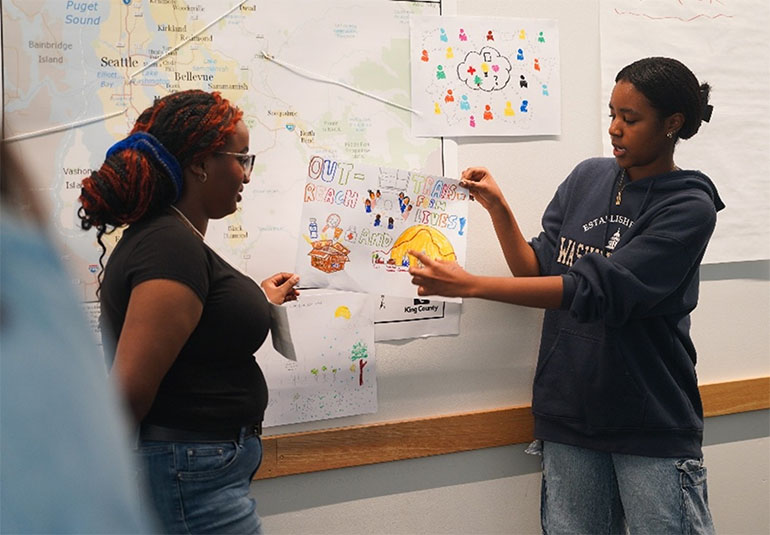
- Outreach & Transform Lives: Outreach & Transform Lives is dedicated to empowering East African immigrants in King County through advocacy, education, and community engagement, and empowering youth leadership on environmental justice and other issues. Funding will support the group’s Community Heat Safety Resource Kits & Education Initiative, which aims to improve heat resilience among African immigrant and refugee communities in King County, particularly those who have recently arrived as asylum seekers from Kenya, Tanzania, Angola, Congo, and Zambia. The project addresses the growing risk of extreme heat by distributing 150 culturally tailored Heat Safety Kits and providing a youth-led educational workshop at the Kenya Christian International Community (KCIC) Church in Kent.
- Villa Comunitaria: Based in the South Park area, Villa Comunitaria started as the South Park Information and Resource Center and has evolved into a leadership development center empowering local families in culturally relevant ways. They offer programs on a variety of topics including helping Latinx immigrants navigate the complexities of the United States immigration, housing, health, education, and legal system. CCR Grant funding will support its Salsa De La Vida project, which aims to build food security in South Park's Latinx community through post-harvest food sovereignty activities at Marra Farm. The project will develop sustainable winter farming practices to enhance soil health and climate adaptation, preserve traditional agricultural knowledge, and increase community capacity to respond to climate-related food insecurity.