
 Translate
Fifteen Mile Creek Bridge No. 493C Replacement Project
The replacement bridge opened to traffic on August 25, 2026.
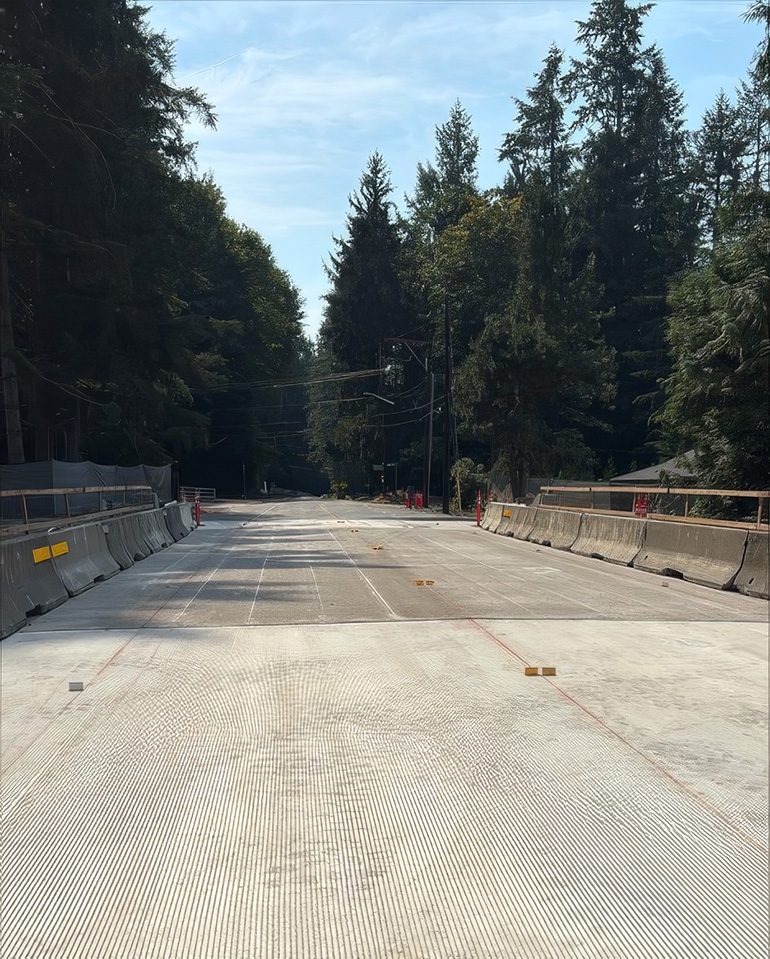
August 25, 2026: The new Fifteen Mile Creek Bridge #493C opened to traffic on August 25, 2026, after 10 weeks of construction. Remaining work will take place under lane restrictions, allowing travelers to continue using this important corridor before the start of the 2026–2027 school year.
Status update
August 25, 2026
Contractor crews working for King County reopened Fifteen Mile Creek Bridge #493C on SE May Valley Road, just west of Issaquah Hobart Road SE, to all traffic on Tuesday, August 25, 2026.
Crews worked diligently to reopen the road before the start of the 2026–2027 school year.
Travelers should expect intermittent lane restrictions through October 2026.
Road Services and contractor crews will complete final touches and restoration work, and utility crews will finish remaining utility relocation through October. During these occasional short term lane reductions, alternating two-way traffic will be directed by flaggers. Emergency responders and school buses will be prioritized. Please expect delays.
This work may be delayed due to crew or equipment availability or weather conditions. Please check My Commute for the most up-to-date status.
Project documents:
Project area map
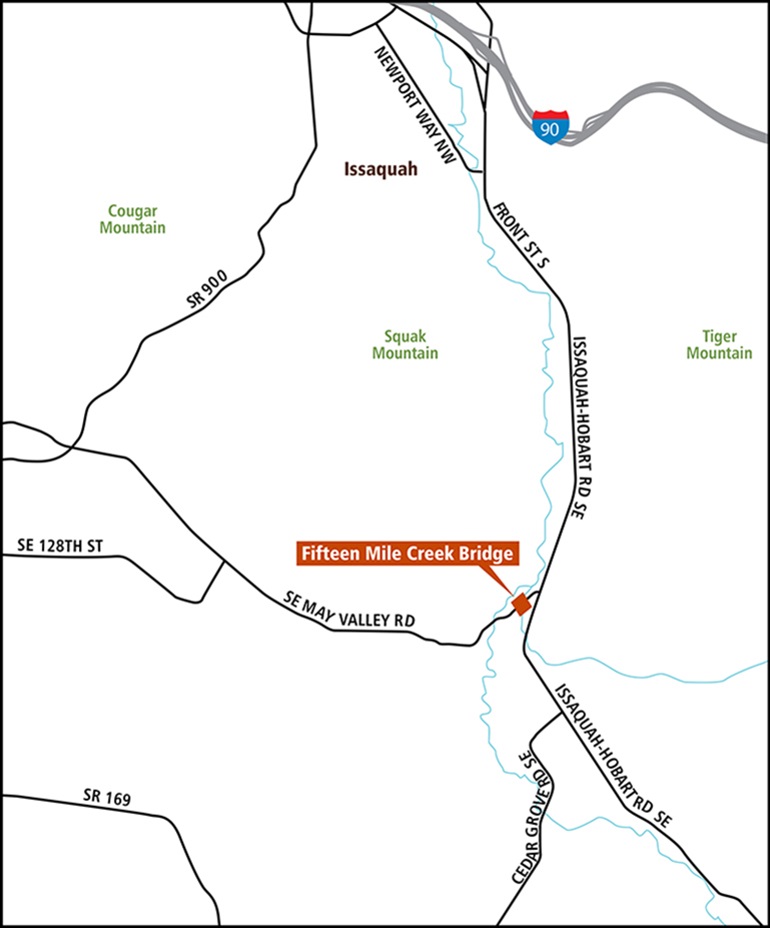
Map showing the Fifteen Mile Creek Bridge Replacement Project location on SE May Valley Road, just west of the intersection with Issaquah-Hobart Road SE. Larger view of the map (1MB)
Why did King County replace this bridge
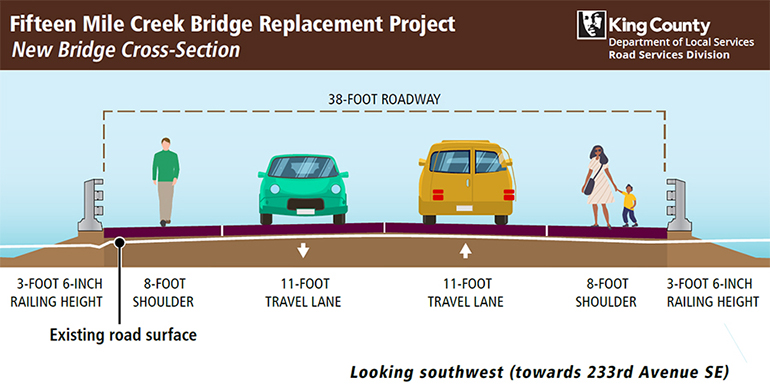
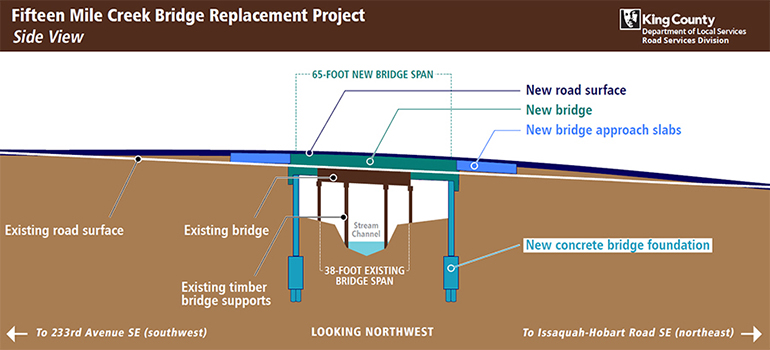
Larger view of the cross-section graphic (361KB)
We replaced the Fifteen Mile Creek Bridge because it was past its useful life. We repaired the previous bridge many times over the years, and it was time to replace it. The new bridge was designed to meet current national bridge standards. These standards include weight capacity, lane and shoulder widths, and environmental protection.
Improves safety by:
- Adding standard 8-foot shoulders on each side of the bridge for people walking, biking, and rolling.
- Increasing the height of the bridge railings by 14 inches, enhancing safety in the event of a collision.
- Raising the height of the bridge over the creek, providing more room for water to flow underneath during high-water events.
Environmental benefits:
- The previous wooden bridge support piles were treated with creosote, which can be harmful to fish and the environment. This project removed the creosote support piles from the stream and replaced them with an out-of-water steel and concrete support system.
Maintains reliable routes for the community:
- The Fifteen Mile Creek Bridge replacement project is a long-term investment in route reliability, maintaining the connections between Issaquah, Maple Valley, and Renton. In 2009 and 2010, we also replaced two other bridges on the route connecting SR 900 and Issaquah-Hobart Road SE.
Getting through the construction zone
Construction began on June 15, 2026 to avoid the rainy season and minimize impacts on school bus service during the school year. We studied the option of building a temporary bridge during construction, but our studies showed that a temporary bridge would double construction time, be more expensive, and increase impacts on the environment, immediate neighbors, and the traveling public.
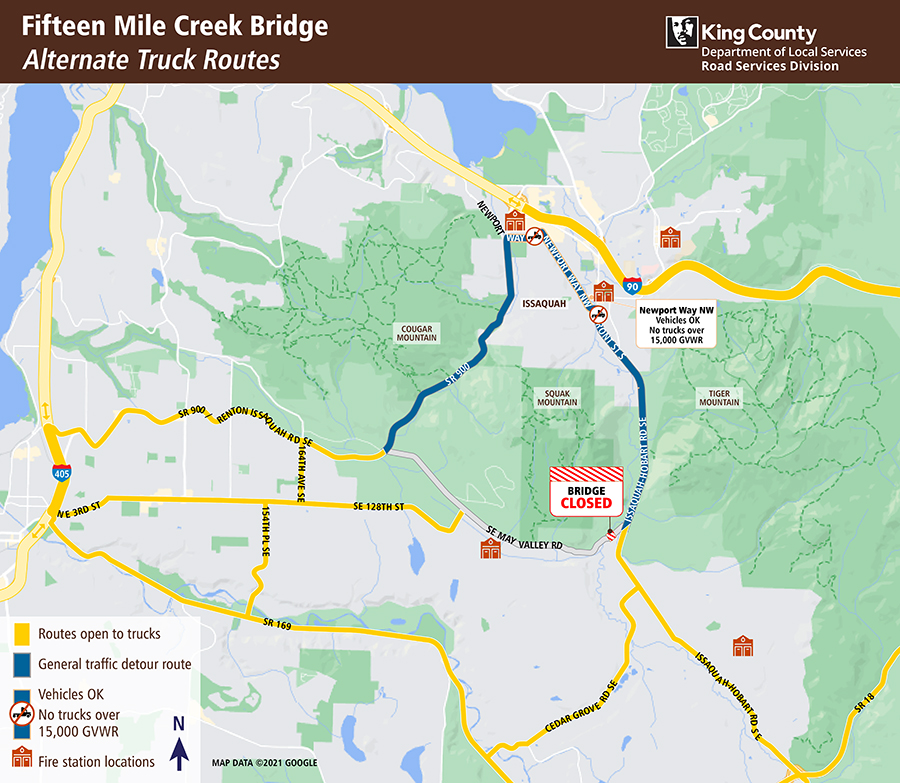
The bridge was closed during construction, and a temporary signed detour route was in place.
Temporary detour route
A general traffic detour route was in place while SE May Valley Road was closed for construction.
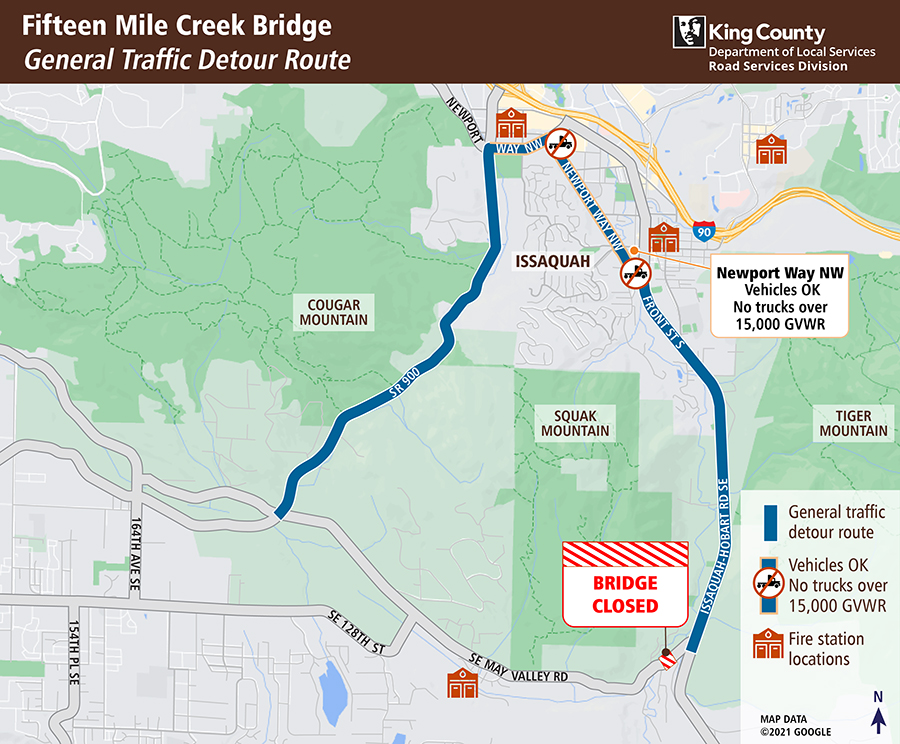
Alternate truck routes
Trucks are not allowed on roads in downtown Issaquah, including SE Newport Way, so they were required to use alternate routes such as State Route 169, State Route 18, Interstate 90, Cedar Grove Road SE, and SE 128th Street during the project.
Project schedule
The full road closure to replace the Fifteen Mile Creek Bridge #493C began on June 15, 2026. The work took approximately 10 weeks to complete.
- Advertised project to contractors: 2025
- Construction started: June 15, 2026
- Major work complete: August 25, 2026
Budget and funding
The estimated total project budget is $6 million, which includes engineering studies and design, environmental documentation and permitting, right-of-way acquisition, construction, inspection, and project closeout. The project is funded with a federal bridge grant.
Frequently asked questions
The new bridge is 38 feet wide, with two 11-foot-wide travel lanes and two 8-foot-wide shoulders. The span (length) of the new bridge is 65-feet-long. The longer span allows the new concrete bridge footings to be located outside of the stream channel. The previous bridge was 27-feet-wide and 38-feet-long.
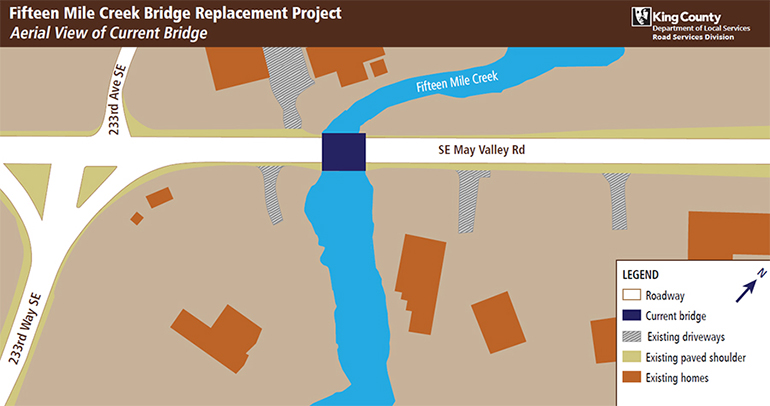
The new bridge was built in the same location as the existing bridge. This project did not change anything about the location of the road or the bridge.
Why did Road Services close the road for bridge construction during the summer only?
- There is more daylight, temperatures are warmer, and there is less rain, which allows our contractor to get more work done during the day.
- This time of year, is also known as the fish window, which is the period when it is safe to perform in-water construction work without disrupting salmon migration.
- Closing the road during the summer allows us to keep the road open during the school year, which helps buses and people driving children to school avoid detour delays.
While flooding has never over-topped onto the roadway, we are preparing for the possibility of higher water events due to climate change.
The new bridge raised the bridge deck higher from the stream bed than the previous bridge.
Raising the bridge deck creates more space for the water and floating debris to move freely under the bridge, even during high-water events. The higher bridge deck also reduces the risk of flooding onto the roadway and provides a larger opening for floodwaters to pass through, which reduces flood levels along the stream.
King County Road Services Division worked closely with Eastside Fire & Rescue, Bellevue Fire, Puget Sound Regional Fire Authority, and the Renton Regional Fire Authority. The Eastside Fire & Rescue deputy chief of operations has asked us to reassure community members near the bridge and in Mirrormont that they did not expect any change to emergency response times and that their coverage remains strong. Even when the bridge was closed, King County has been told three other stations in the Issaquah area are positioned to reach nearby neighborhoods quickly.
Eastside Fire & Rescue also shared that, before Station 78 opened in 2016, Station 71 was the primary responding engine for the Mirrormont community. Throughout the SE May Valley Road closure, TriMed Ambulance posted an additional unit at Station 71 each day from 6 am to 8 pm. During this period, TriMed handled transports for the area, which will help keep more Eastside Fire & Rescue units available to serve the community.
For major incidents, the regional system continued to automatically dispatch the closest available units, including support from their partners in Puget Sound Fire. That coordinated response model did not change during the closure.
In addition, Station 76 within Mirrormont hosted the Washington State Department of Natural Resources wildland crews in summer 2026 and provided extra seasonal coverage to help reduce concerns about wildfire response.
Photos
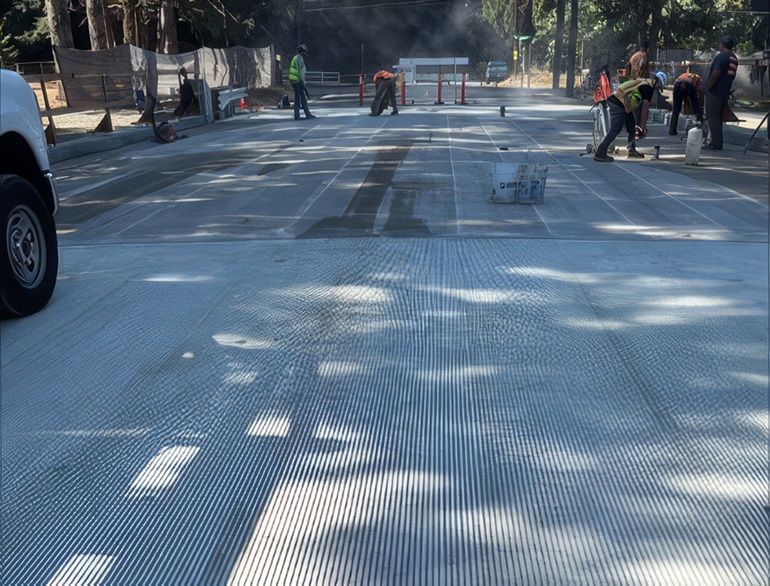
August 22, 2026: Polyester overlay, shown in the foreground, was used on the Fifteen Mile Creek Bridge to speed up the project timeline. The material cures in just a few hours, compared to concrete, which typically needs 10 to 14 days before it can carry traffic. This allowed crews to reopen the road much sooner while still providing a durable, long lasting surface.
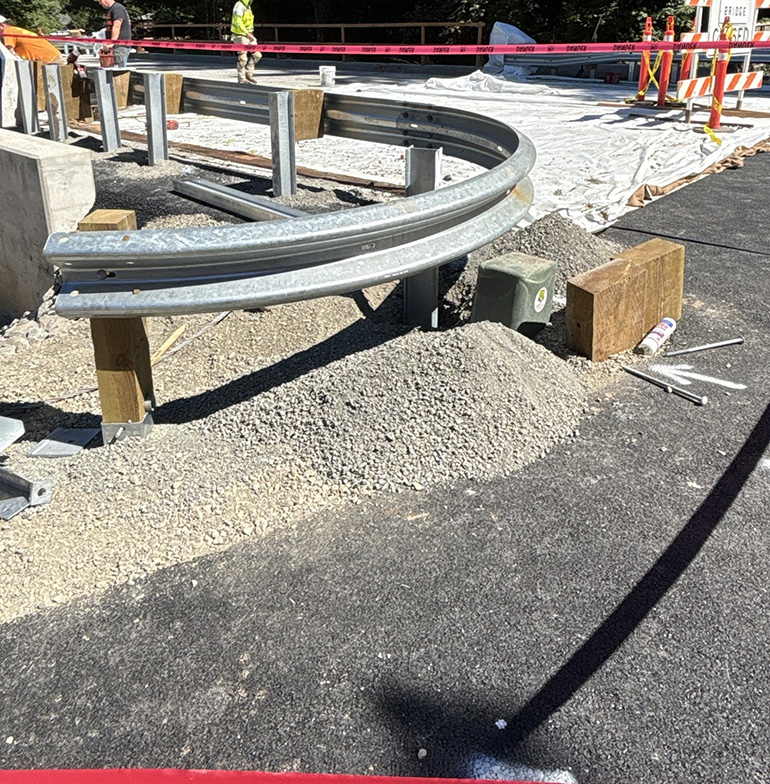
August 20, 2026: Newly installed guardrail along the side of the bridge.
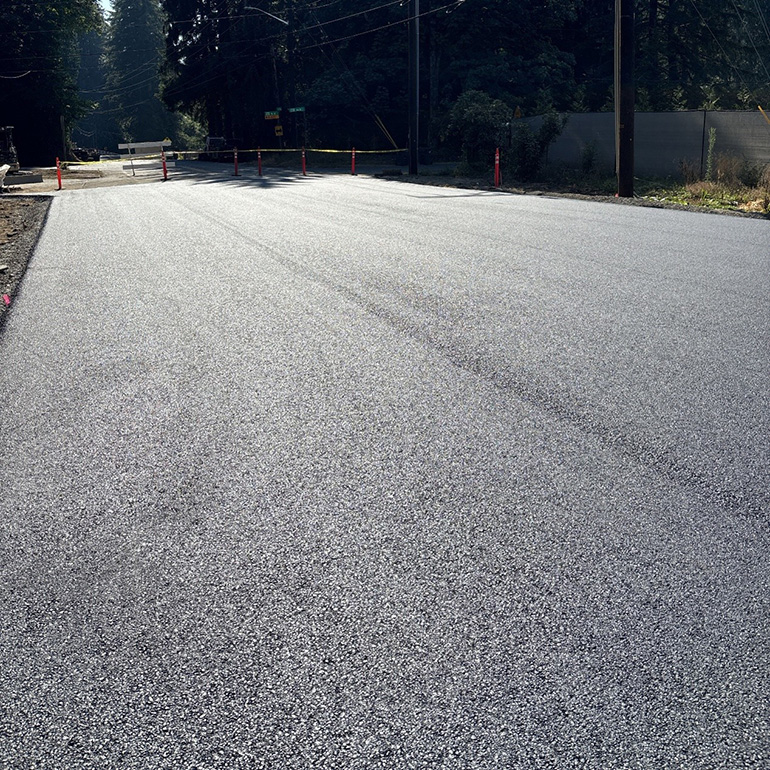
August 18, 2026: A newly paved section of SE May Valley Road.
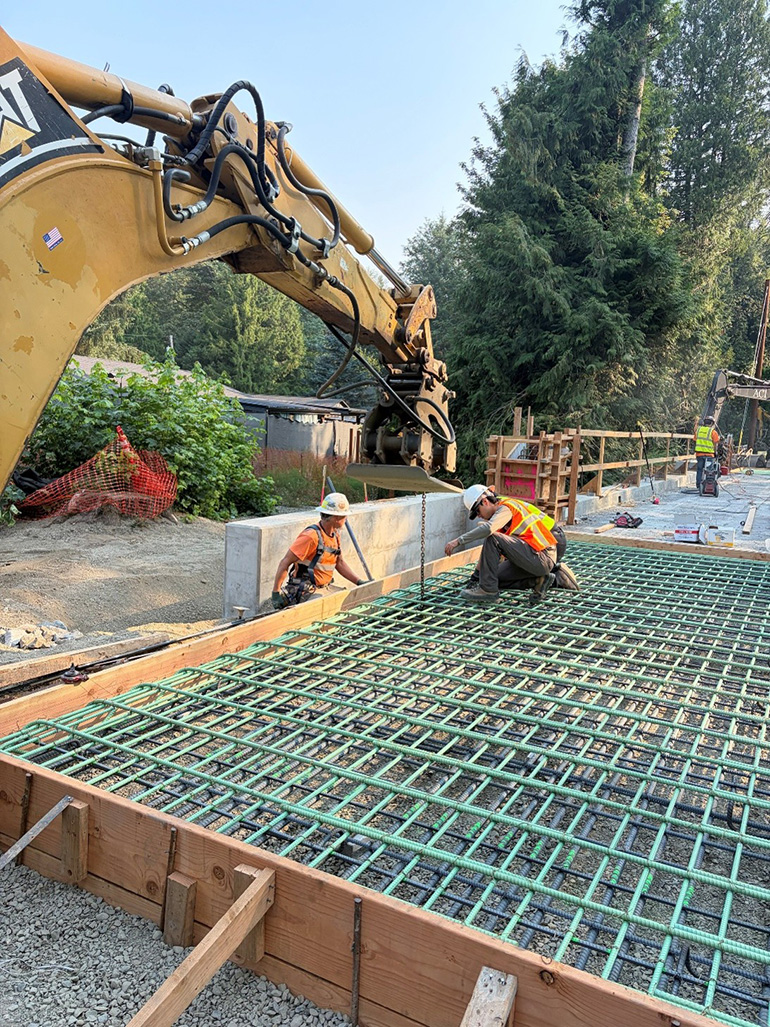
August 13, 2026: Crews are preparing to pour concrete for the bridge approach, where the bridge meets the roadway.
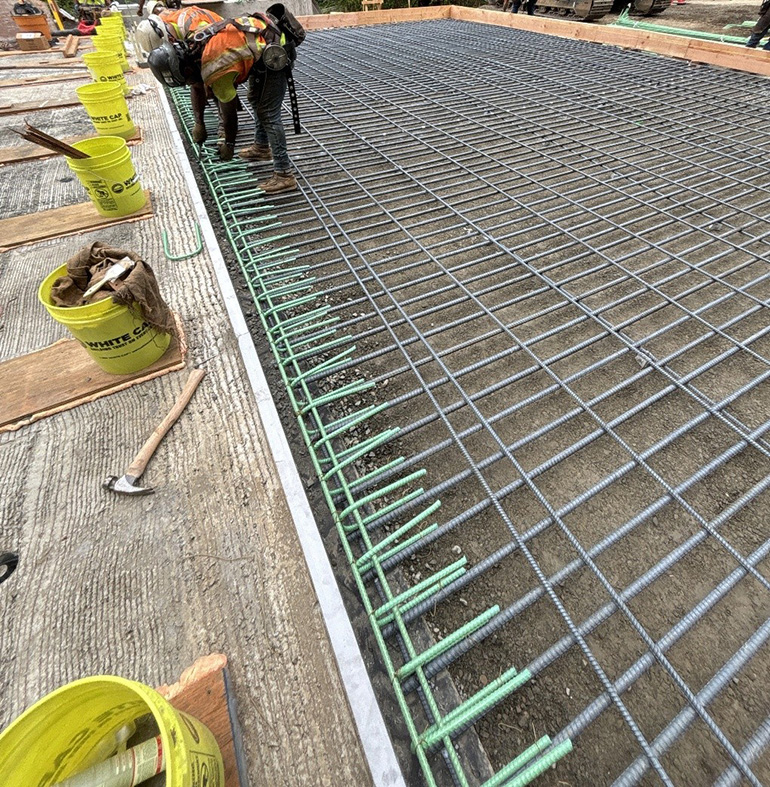
August 10, 2026: Rebar is being installed to the bridge approach.
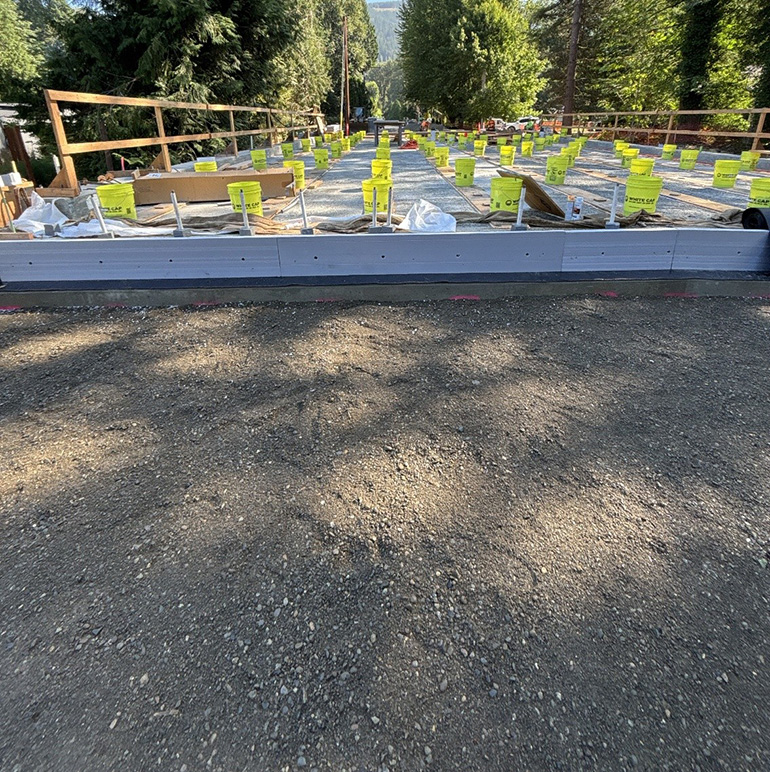
August 9, 2026: UHPC (ultra-high performance concrete) was poured between the girders.
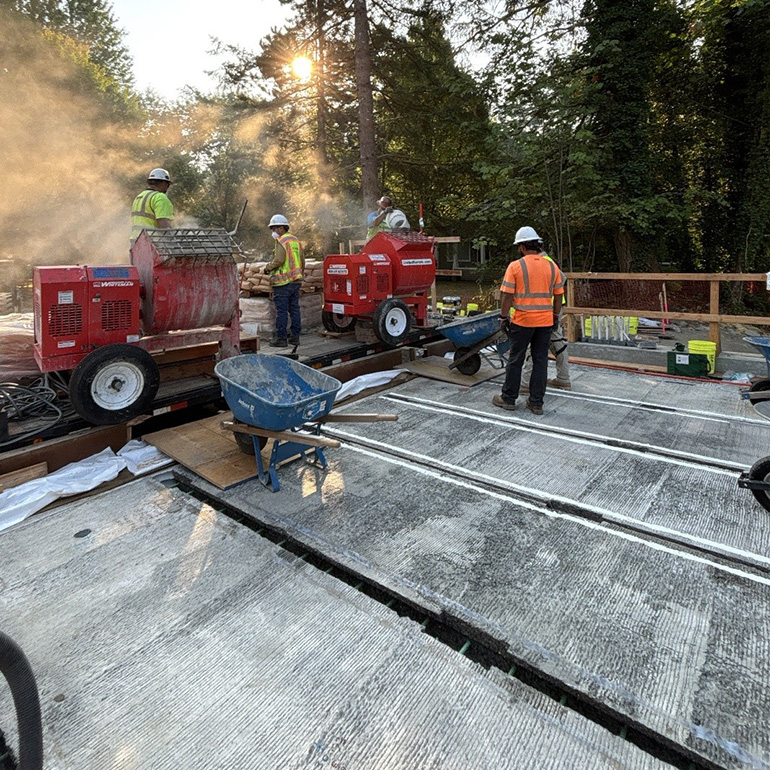
August 7, 2026: Crews are pouring UHPC (ultra-high performance concrete) in between the girders to connect them and provide stability to the structure.
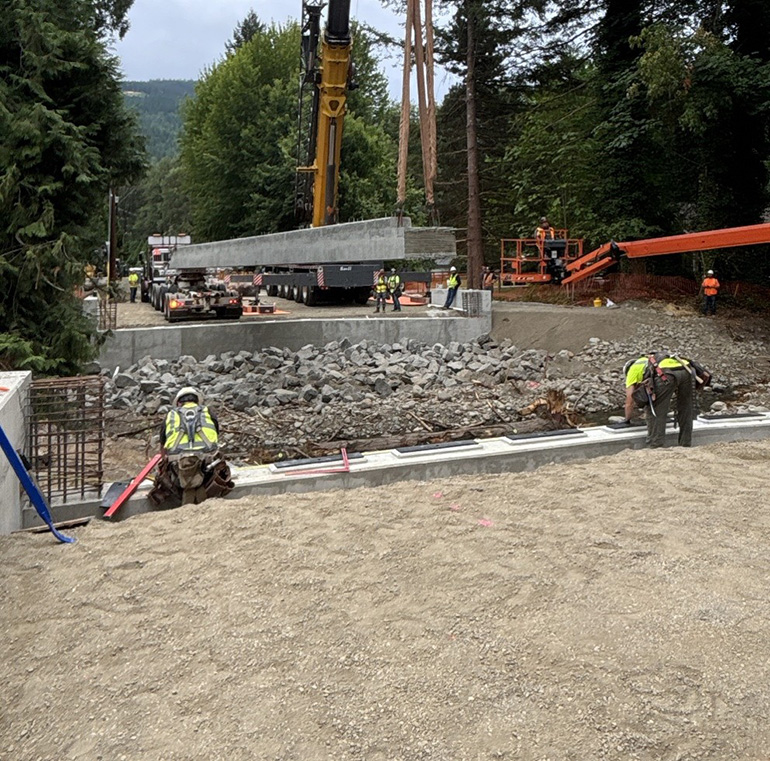
July 28, 2026: Crews are installing the girders, the primary horizontal support structure for the bridge.
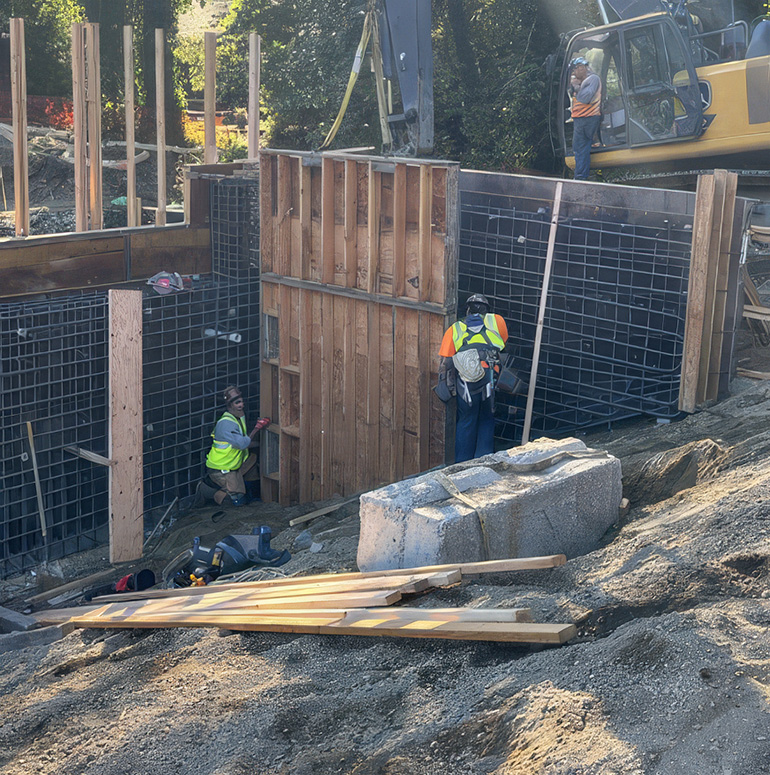
July 14, 2026: Crews are constructing bridge abutments and wingwalls, the structures that support the ends of the bridge.
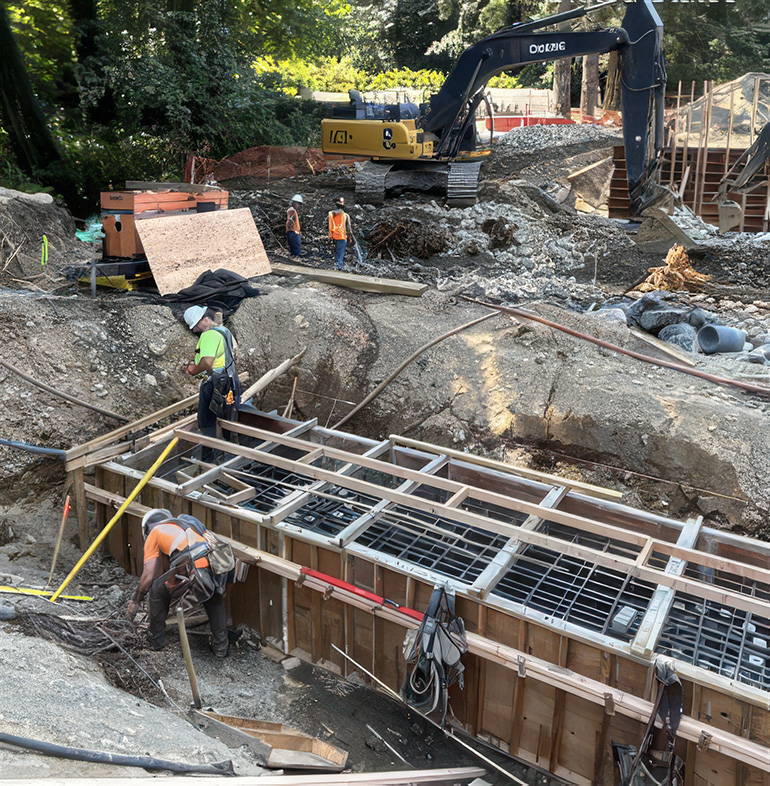
July 13, 2026: Crews are completing work on the shaft cap, which will shape and support the concrete once it’s poured.
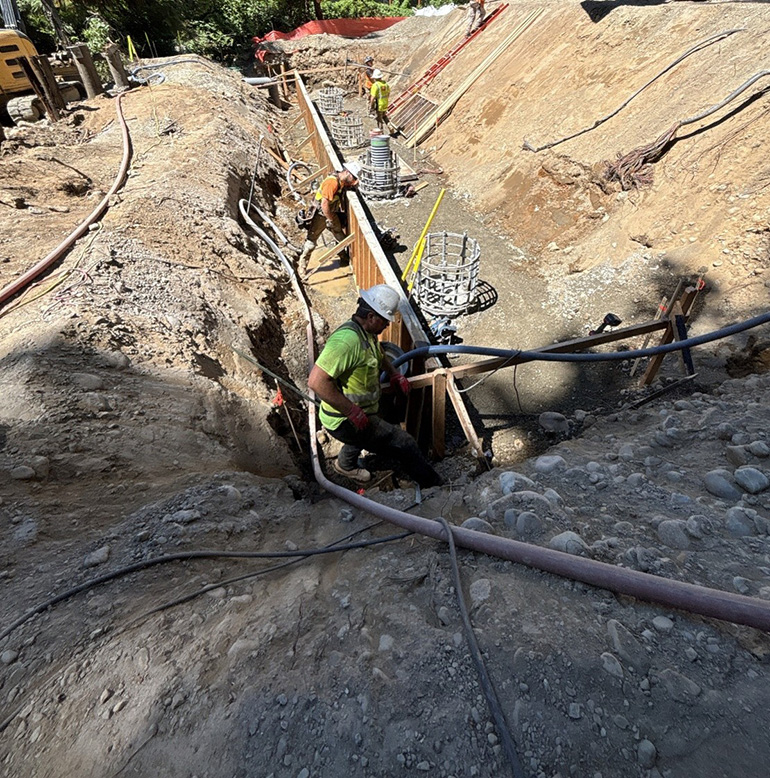
July 13, 2026: Crews are completing work on the shaft cap, which will shape and support the concrete once it’s poured.
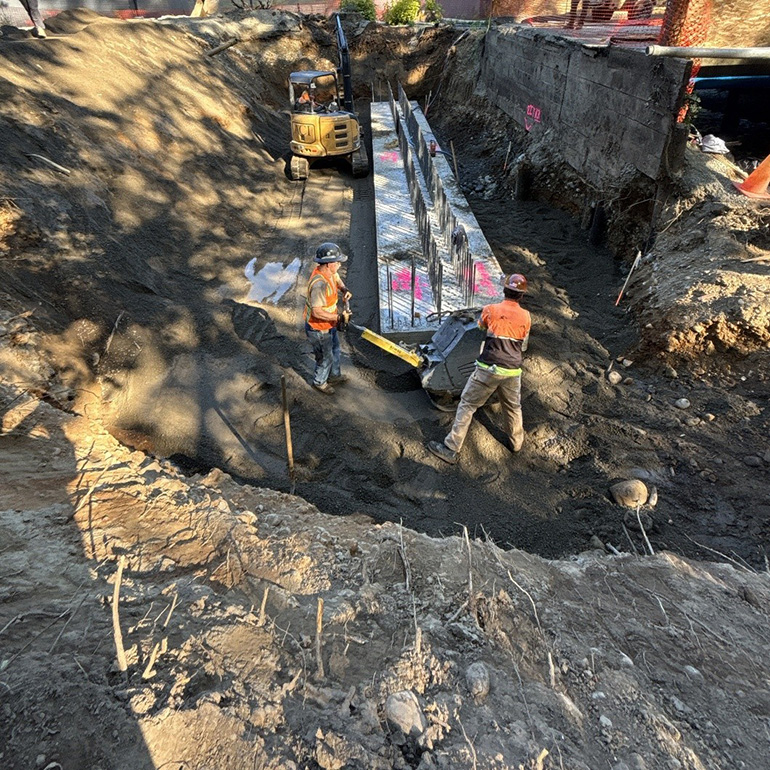
July 7, 2026: Crews are applying gravel backfill for the shaft cap, an important step that helps stabilize the structure.
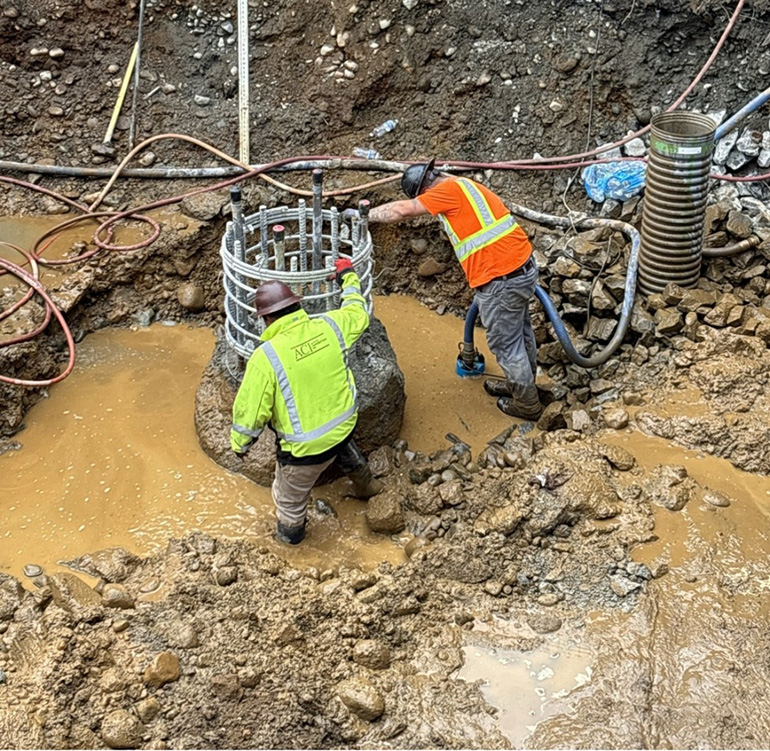
June 29, 2026: Crews are using a “sump pump” to remove water from the shaft so they can keep working safely.
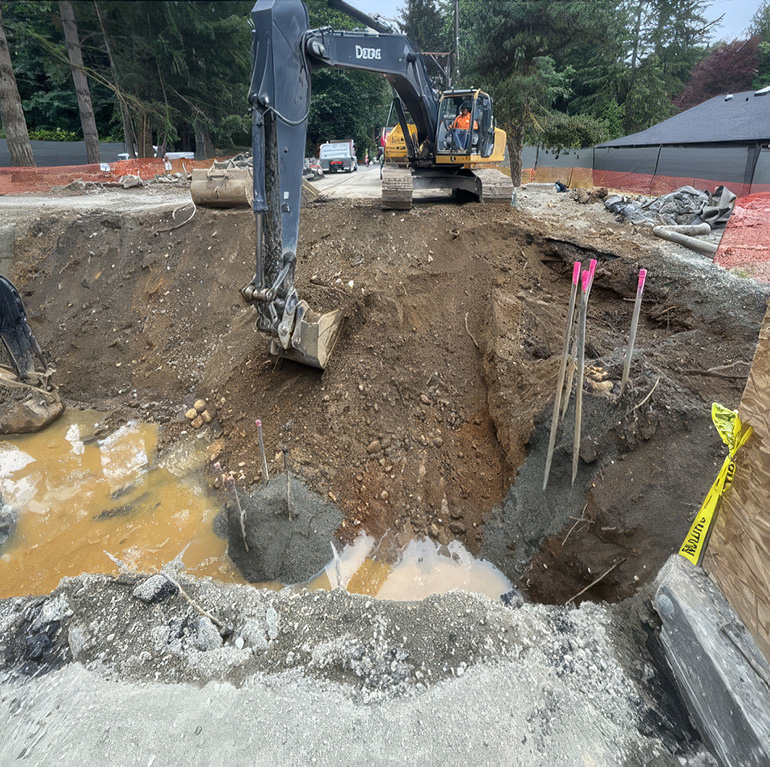
June 28, 2026: Crews are digging out the area to create the right slope for the bridge shafts. This gives workers safe, stable access to the foundation.
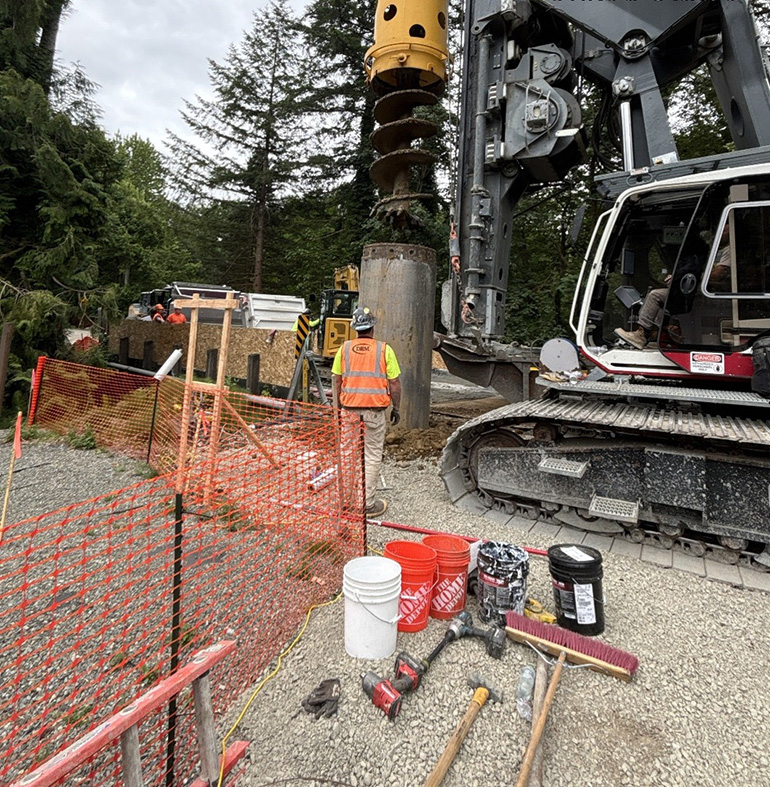
June 20, 2026: Crews are drilling a deep hole and placing a casing inside it as they drill. This keeps the hole from collapsing and helps form the bridge structure.
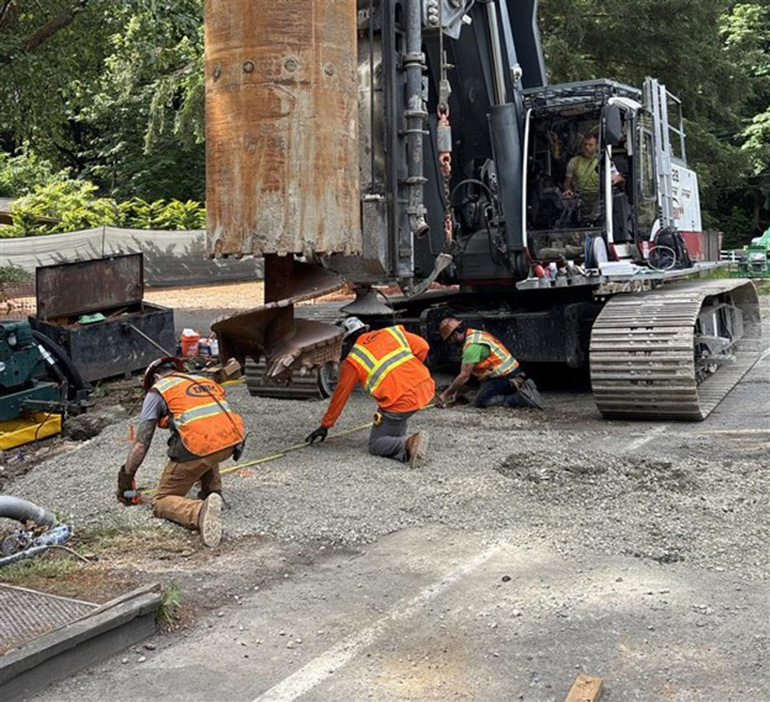
June 17, 2026: Crews are taking measurements to ensure the drilled shaft, a deep concrete foundation that will support the bridge structure, is placed in the right spot.
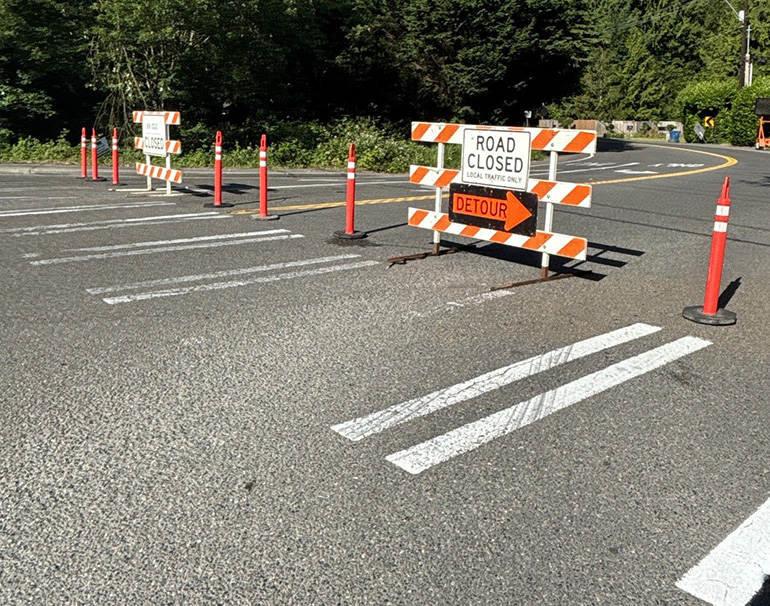
June 15, 2026: A 10-week closure of SE May Valley Road near Issaquah-Hobart Road SE began to allow for the removal and replacement of Fifteen Mile Creek Bridge #493C.
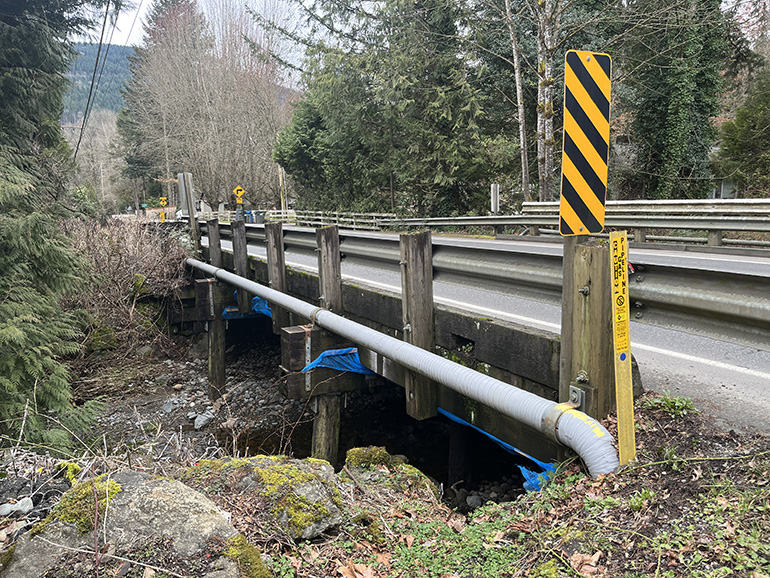
February 2026: Crews added blue netting under the bridge to prevent birds from nesting. Because the existing structure will be demolished during construction, these measures help prevent active bird nests from being disturbed or harmed.
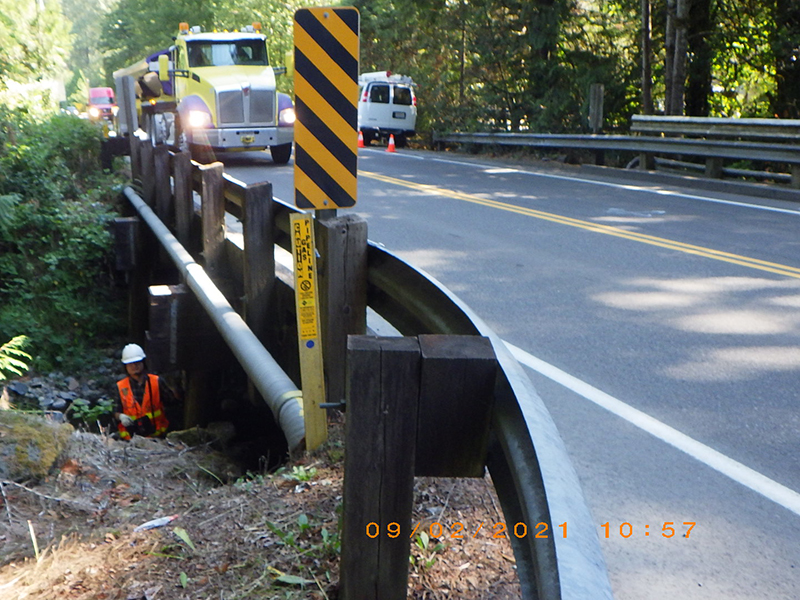
The existing bridge does not have shoulders. The new bridge adds two 8-foot shoulders to the roadway.
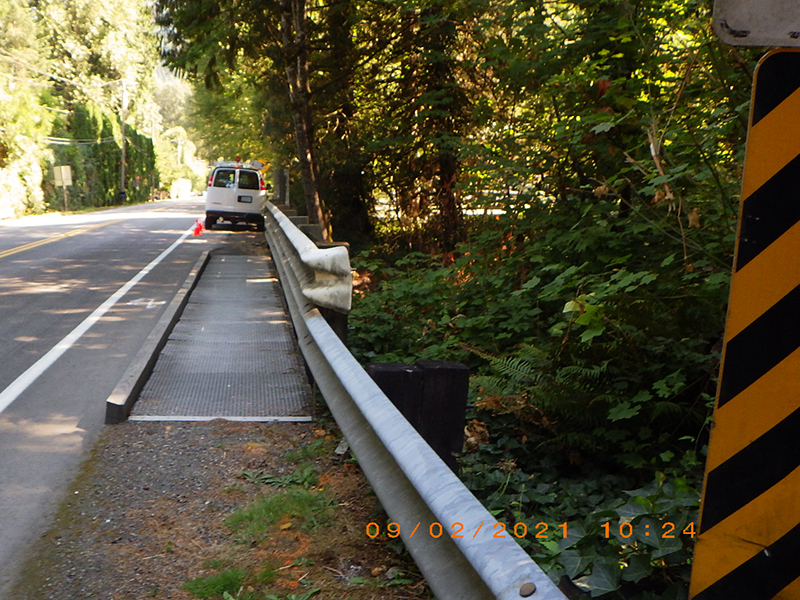
The existing bridge has a pedestrian sidewalk on one side of the bridge. The new bridge will have pedestrian pathways on both sides of the bridge.
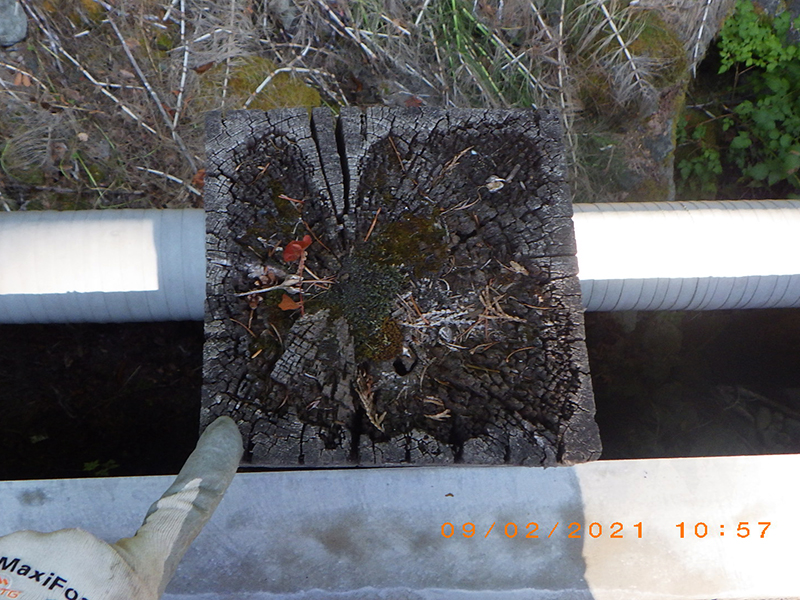
The wooden guardrail posts are aging and worn out. The project will replace the old wooden posts with a new, all-steel guardrail system.
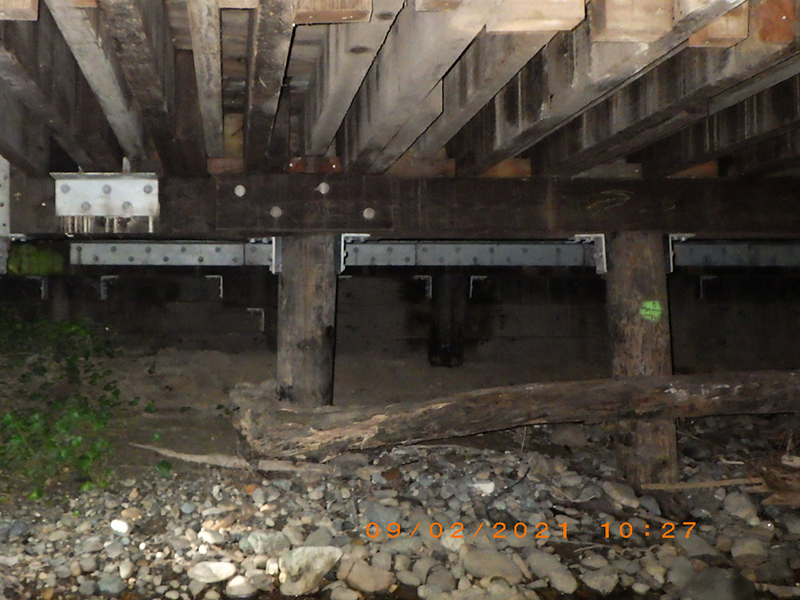
King County Road Services installed steel supports under the existing bridge to help strengthen the old, worn-out timber cross beams.
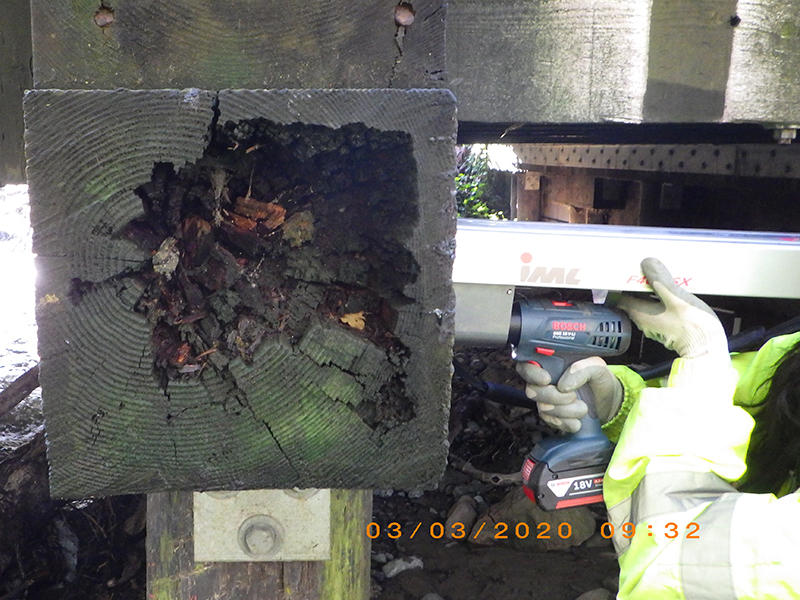
Some of the timber support beams on the existing bridge are worn out. The new bridge replaces the timber beams with concrete bridge foundations.
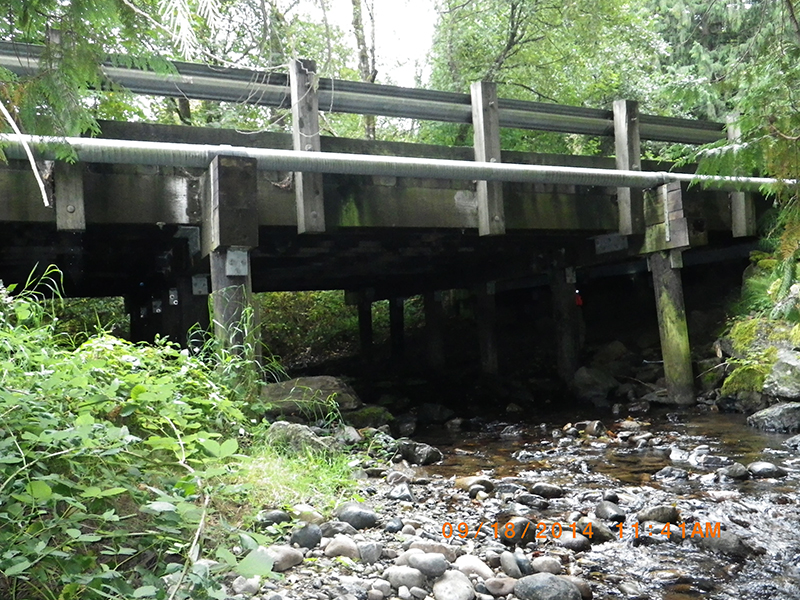
From this view of the bridge looking south, see the creosote-treated timber piles which are touching the water.